
News and Announcements
Press Release-Fishing Prohibitions Unfair: Council Pushes for Analysis of Fishing in Marine Monuments (16 December 2025)
 HONOLULU (16 December 2025) The Western Pacific Regional Fishery Management Council today took another step toward restoring sustainable commercial fishing in waters within several Pacific marine national monuments, considered pristine when they were established. The Council directed its staff to continue analyzing existing regulations in the Pacific Islands Heritage, Rose Atoll, Marianas Trench and Papahānaumokuākea Marine National Monuments (MNMs), with a final recommendation planned for consideration at its March 2026 meeting.
Recent presidential directives have instructed federal agencies to identify ways to reduce regulatory burdens and expand opportunities for commercial fishing in monument waters. In response, the Council is preparing a range of options aimed at returning commercial fishing to these areas under sustainable management.
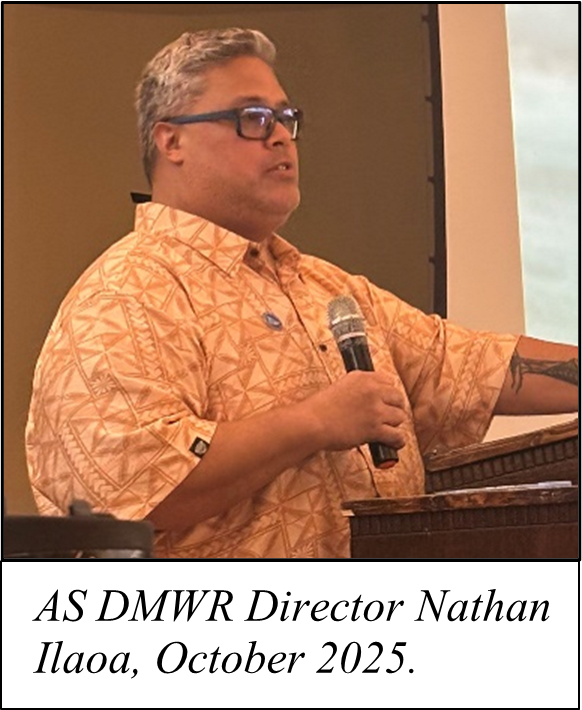
“Prior to the establishment of the monument in 2009, we stewarded our own waters. With the monument, only the feds are in charge and no one else has a say,” said Council member Nathan Ilaoa, director of American Samoa’s Department of Marine and Wildlife Resources. “This initiative before the Council provides an opportunity to talk about how the people want to manage their resources rather, than being told what to do by the feds,” he said. The Council also supported a recommendation to ask the president not to use the Antiquities Act to manage fisheries in federal waters.
Ilaoa said monument fishing prohibitions undermine the people’s ability to fish and provide food for the community. “Pacific Island people are unfairly required to bear the burden of the country’s environmental guilt, and the monuments represent a large inequality in how our peoples are treated,” he said.
Council members wrestled with potential enhanced management measures and stressed the need for additional data. Council Chair Will Sword said, “If you don’t go fishing, you can’t get the data.” Council member Gene Weaver added, “The Council’s existing regulations provide more than adequate protection, and we can learn from the fishing that occurs to determine if anything more is needed.” Members emphasized that if commercial fishing is restored, it must be done the right way: under existing federal fishery management authority, with strong monitoring and clear performance measures.
An important part of the Council’s fishery management decision-making process is the opportunity for community members to provide their input on issues discussed. During the public comment period, commenters were split: several supported reopening monument waters, especially the Marianas Trench, if done cautiously under enhanced regulations (gear and catch limits, protected-species measures, strong monitoring) and paired with baseline studies and adaptive management to support local livelihoods and food security. Others urged no action and keeping existing protections, particularly for Rose Atoll and Papahānaumokuākea, citing the areas’ sacred cultural importance, concerns about inadequate consultation and legal authority, and potential ecological harm.
The Council acknowledged letters to NOAA from the governors of American Samoa and the CNMI supporting fishing. However, one member expressed disappointment with the governor of Hawaiʻi’s letter to NOAA to keep fishing prohibitions in the Papahānaumokuākea and Pacific Islands Heritage MNMs. He argued that locally based, well-managed fisheries are integral to Hawaiʻi’s food security and economic fabric, and noted that the state’s longline fisheries represent its largest agricultural product. He urged greater consideration of Hawaiʻi’s fishermen in any decisions affecting these waters.
By the numbers:
- Wild-caught pelagic fisheries in the Western Pacific generated around $108 million in revenue in 2024, including about $105 million from the Hawaiʻi longline fishery (2024 Council Stock Assessment and Fisheries Evaluation report).
- Hawaiʻi’s seafood consumption is among the highest in the United States, estimated at more than twice the national average. Once local catch is transformed into value-added products like poke, its economic contribution grows even further.
- For context across primary production in Hawaiʻi, USDA reports 2024 values of ~$53 million for coffee and ~$42 million for macadamia nuts.
The Council also recommended the National Marine Fisheries Service (NMFS) provide funding to the Pacific Islands Fisheries Science Center to implement cooperative research that partners with commercial fishers to collect baseline information in monument waters.
The Council also endorsed Scientific and Statistical Committee research priorities, including:
- Collecting catch/bycatch data suitable for model-based evaluation of policy impacts
- Assessing foreign fishing impacts versus domestic fishing near U.S. waters
- Tagging/telemetry and other low-impact research to evaluate species movement
- Assessing monument-related fishery impacts on markets
- Co-designing research with fishing and indigenous communities, as appropriate
Council Executive Director Kitty Simonds said research funding is needed to keep fisheries sustainable and protected. “While it is NMFS’s job to do research, funds are not available because the administration has to deal with other pressing issues,” said Simonds. “Organizations that helped the government establish the monuments have an obligation to help make this happen.”
What’s next
Council staff will complete the requested analyses and draft Fishery Ecosystem Plan amendment alternatives for review ahead of the March meeting, where the Council is expected to take further action on restoring access and finalizing a durable management path forward.
NMFS is expected to share Executive Order 14276 public comments with the Council by early January 2026, followed by January discussions with NMFS on comment summaries and prioritizing next steps, consistent with NOAA guidance from Eugenio Piñeiro Soler.
2026–2029 CNMI Bottomfish Catch Limits
The Council recommended setting the annual catch limit (ACL) for the CNMI bottomfish fishery at 72,000 pounds and the annual catch target (ACT) at 66,000 pounds for 2026–2029. These specifications are based on the results of the NMFS 2025 stock assessment update, along with application of the Council’s P* and SEEM analyses to account for scientific and management uncertainty. The ACT was set below the ACL to provide a management buffer that helps prevent the fishery from exceeding the ACL, ensuring catches remain within sustainable limits.
How to Join the Council Meeting
The Council meeting continues virtually tomorrow, 11 a.m. to 5 p.m. Hawai‘i time with an Endangered Species Act review for the Hawai‘i deep-set longline fishery, vessel electronic monitoring and more. The agenda includes scheduled public comment periods.
💻 Online: https://tinyurl.com/205CouncilMtg, Event password: CM205mtg
📜 Get the full agenda & documents: www.wpcouncil.org/event/205th-council-meeting-virtual-2
Western Pacific Regional Fishery Management Council: Secretary of Commerce appointees from nominees selected by American Samoa, the CNMI, Guam and Hawai‘i governors: Will Sword, American Samoa Power Authority (American Samoa) (chair); Roger Dang, Fresh Island Fish Co. (Hawai‘i) (vice chair); Edgar Feliciano, Feli Fisheries Inc. (American Samoa); Pete Itibus, noncommercial fisher (CNMI); Frank Perez, AC Sales and Service, (Guam); Matt Ramsey, Conservation International (Hawai‘i); Jesse Rosario, Guam Fishermen’s Cooperative Association (Guam); and Gene Weaver, Tasi to Table (CNMI). Designated state officials: Dawn Chang, Hawai‘i Dept. of Land & Natural Resources; Sylvan Igisomar, CNMI Dept. of Lands & Natural Resources (vice chair); Nathan Ilaoa, American Samoa Dept. of Marine & Wildlife Resources; and Chelsa Muña, Guam Dept. of Agriculture. Designated federal officials (voting): Sarah Malloy, NMFS Pacific Islands Regional Office. Designated federal officials (nonvoting): Jeremy Raynal, U.S. Fish & Wildlife Service; RADM Sean Regan, U.S. Coast Guard Oceania District; and Rachel Ryan, U.S. State Dept.